CN Codes
A commodity code (UKTZED in Ukraine, the ten-digit HS-based classification) is how customs knows what is crossing the border and how the tax office knows what has been sold. The code sits on the item card under the "Stock" tab, while this register keeps the list of codes the company uses, together with their duty rates.
Where to find it: Modules → Stock → Registers → CN Codes
A worked example
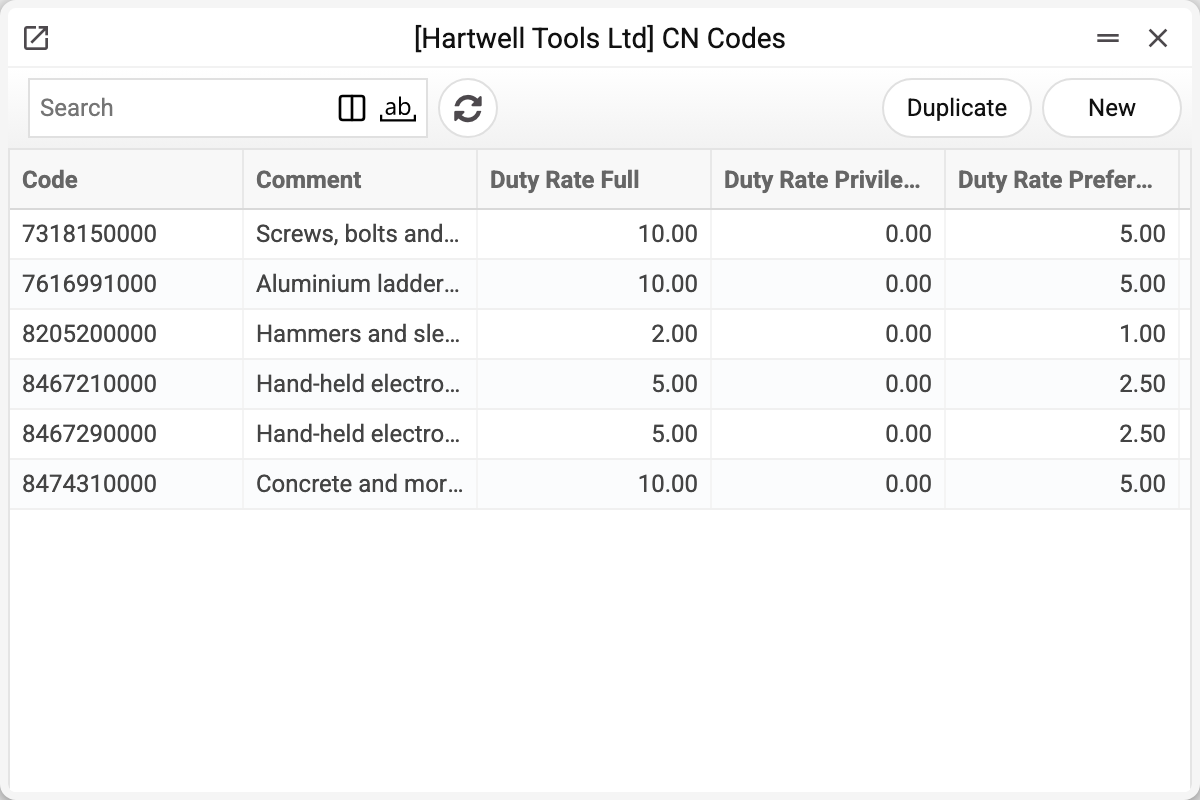
Six codes are enough for a tool shop's range: drills, other hand-held electromechanical tools, hammers, screws and bolts, aluminium ladders, concrete mixers.
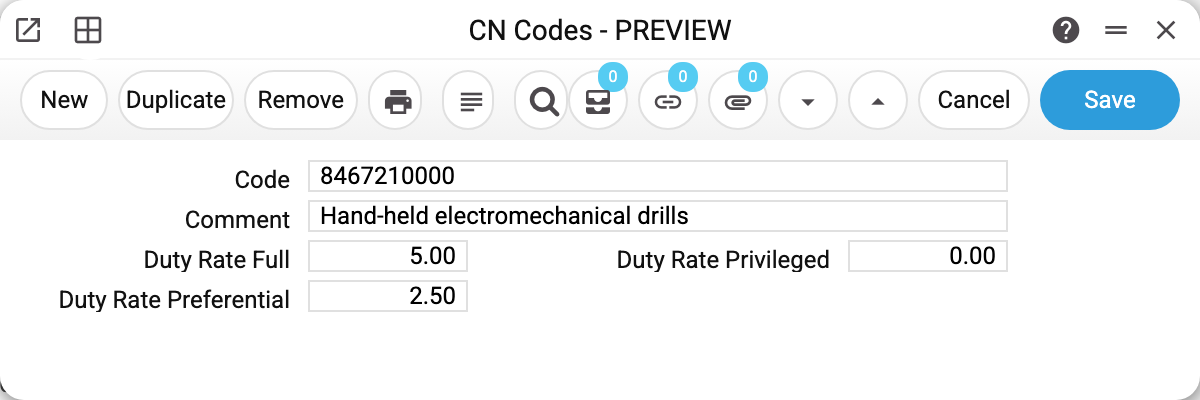
Code 8467210000 "Hand-held electromechanical drills" is the one on the card of the drill from the item example. Besides the code and its description, the card holds three duty rates:
- full — 5.00 %, the base rate;
- preferential — 2.50 %, for countries covered by a trade agreement;
- privileged — 0.00 %, for countries with most-favoured-nation status.
Duty is calculated from these rates in customs clearance: when a code is entered in a section, the system takes the full rate, or the privileged or preferential one if the supplier's card has that "Duty rate type"; the duty amount is calculated from the rate and the section amount. Outside customs clearance the rates are not used.
Where the code shows up
On a tax invoice. When a tax invoice is created from an invoice or a payment, the system takes the commodity code from each item's card and puts it on the invoice line together with the "imported" flag. An empty code on the card means an empty cell on the invoice — and a question from the tax office.
During customs clearance. Customs clearance groups the order lines by commodity code: duty and customs fees are charged per classification position, not against the invoice as a whole.
Typical situations
The code has to be a real one. The system does not check the code format: a placeholder like "CODE1" is accepted and passed into the tax invoice and the Medok export as is — the error comes from the tax office. Take the code from the current classification — ten digits, no spaces.
One code for many items. That is normal: every drill in a category shares one code. The register is meant to be small.
A duty rate changed. Edit the code's card — customs clearances already created are unaffected: the rate is copied into a section when the code is entered there (or the clearance is created from a purchase order) or the rate type is changed.
Where to look next
- Items/Services — where the code is chosen;
- Customs clearance — where codes group a consignment;
- Issued tax invoices — where the code ends up.