Delivery Terms
Who pays for delivery and where the seller's responsibility ends is an agreement recorded on the order. This register keeps the list of such agreements so that nobody retypes them into every document.
Where to find it: Modules → Stock → Registers → Delivery Terms
Incoterms are the usual content, but the format is free: a code and a description.
A worked example
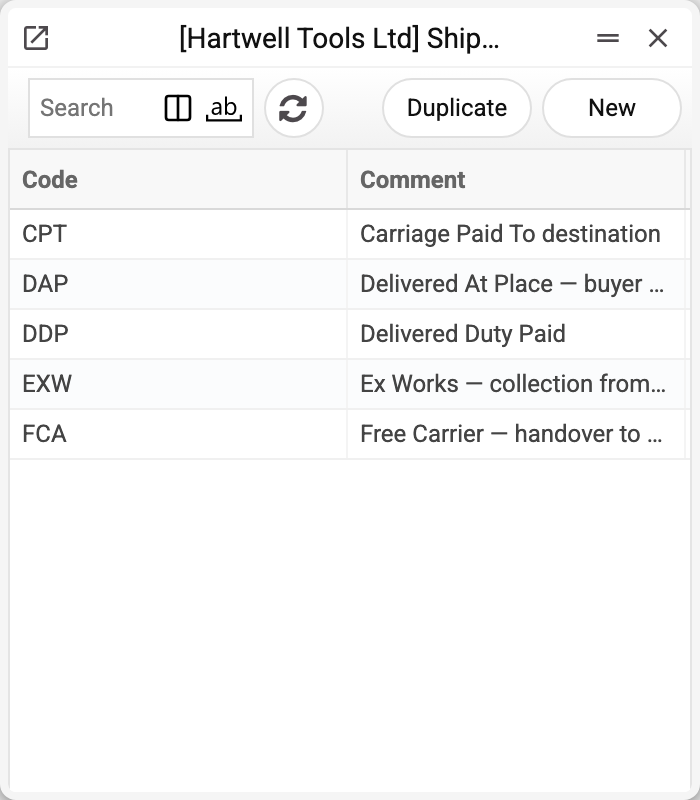
The demo company holds five entries:
| Code | Description |
|---|---|
| EXW | Ex Works — collection from our warehouse |
| FCA | Free Carrier — handover to buyer carrier |
| CPT | Carriage Paid To destination |
| DAP | Delivered At Place — buyer site |
| DDP | Delivered Duty Paid |
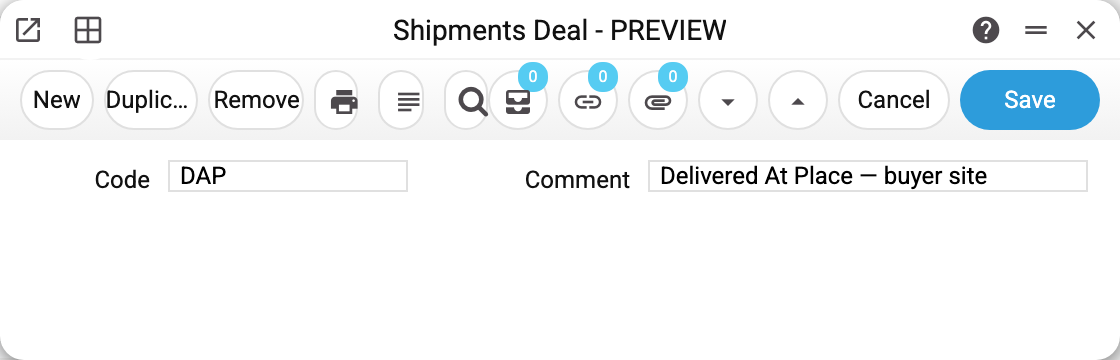
The card holds a code, a description and the "Closed" checkbox. The code is unique; code and description are required. A closed term is not offered in the selection list on the sales order, the invoice and the contract; where it is already set, it stays.
How the term reaches documents
The "Delivery Terms" field, whose values come from this register, exists on the sales order, the invoice and the contract. From there the value travels on its own:
- from the customer card into the order and the invoice, when the customer is picked or changed; empty on the card means empty on the document (a credit note and a till receipt take the term from the card only into an empty field);
- from a quotation into the order, when the order is created from the quotation;
- from a contract into the subscription invoices raised by contract billing;
- from the order into the realisation document.
In the demo company the terms are set on the first three sales orders: No. 1 — DAP, No. 2 — EXW, No. 3 — CPT.
The term affects neither accounting nor postings: it is a detail for the printed form and for the agreement with the customer. Next to it sits the delivery mode — how the goods actually travel.
Typical situations
The term you need is missing. Create a card: code and description. There are no restrictions on the code — Incoterms are simply a habit.
The term did not carry over from the quotation. Then the quotation itself had an empty field: the system copies what is there.
The term is no longer used. Tick "Closed" on its card: the term no longer appears in the selection list, while documents that already carry it keep both the code and the description.
The code is taken. Codes are unique, and the only way to free a code is to delete the card. The system allows that only while the term is not used anywhere — neither in documents nor on contact cards; otherwise it refuses and names the register where the term is used. Such a term is closed, not deleted.
Where to look next
- Delivery mode — the neighbouring field on the document.
- Sales orders — where the term is set.
- Carriers — the actual companies that carry the goods.
Print variables
Values available in this document's printed form templates. How to write a variable in a template — see Print Forms.
Header fields:
| Variable | What it holds |
|---|---|
| ShipD_No | Code |
| ShipD_Comm | Comment |