Asset Types
The register that answers a single question: which accounts to post to for fixed asset operations. The asset card itself knows no accounts — it refers to a type (VEHICLE, BUILDING), and the type says: balance — 105, accumulated depreciation — 131, expenses — 921. So where the postings of commissioning and depreciation land is decided not by the card but by its type.
Where to find it: Modules → Fixed Assets → Registers → Asset Types
Walkthrough
The VEHICLE type in the demo database:
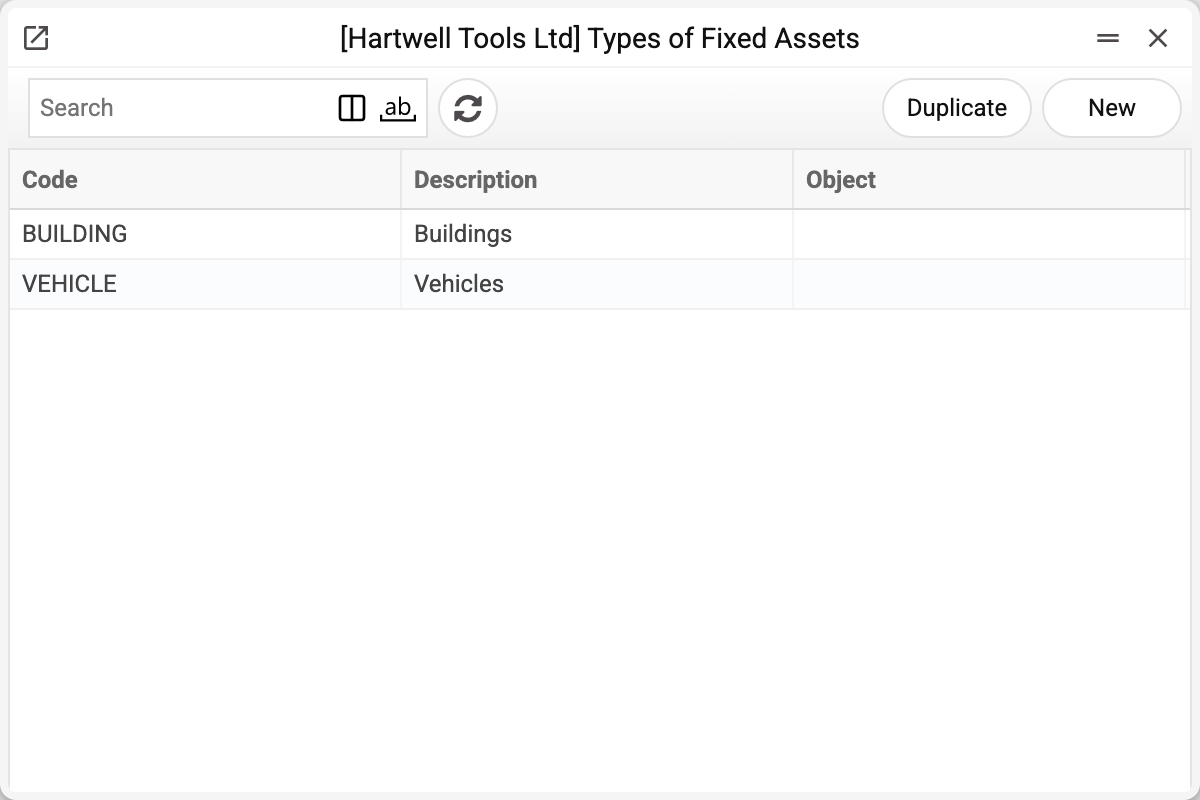
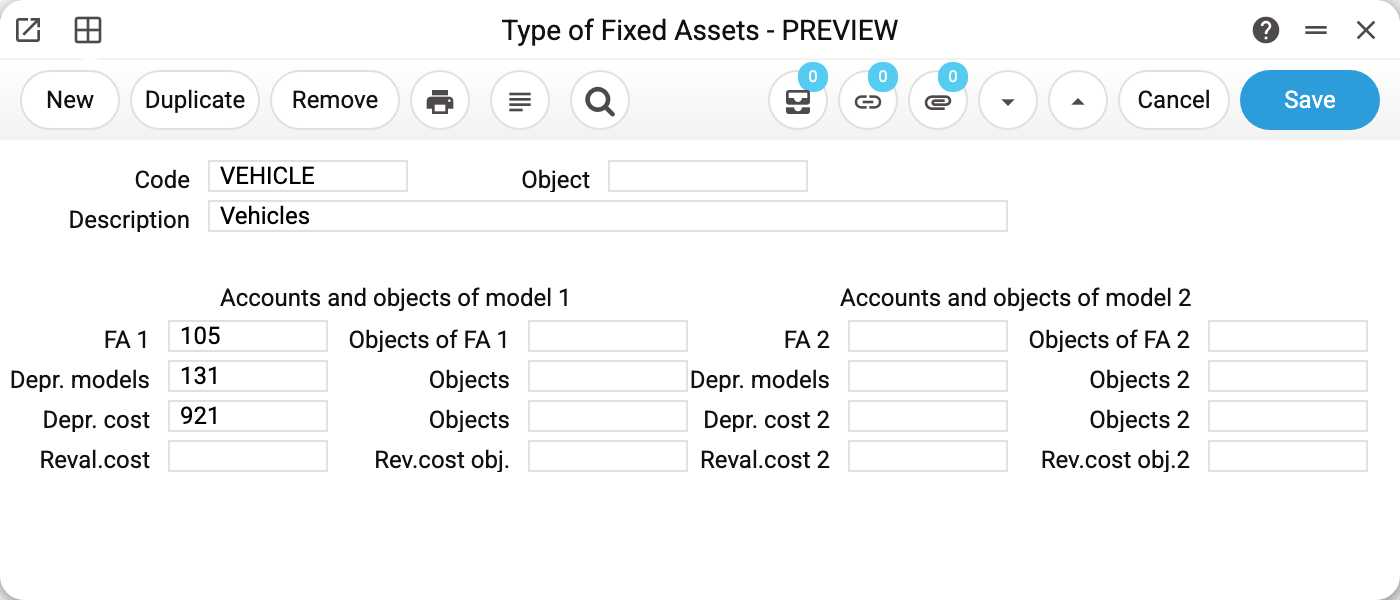
The left column is filled — "Accounts and objects of model 1":
- FA 1 = 105 — the balance account: commissioning puts the object here (for the demo vehicle: Dr 105 Cr 152 for 250,000).
- Depreciation account = 131 — accumulated depreciation: the credit of every charge.
- Depr. cost = 921 — expenses: the debit of depreciation. The monthly posting of the demo vehicle — Dr 921 Cr 131 for 4,166.67 — is assembled entirely from these two fields.
- Reval.cost — the revaluation account. The field is only stored: no operation (commissioning, depreciation, disposal) reads it.
The right column holds the same four accounts for model 2: a parallel set of books (e.g. fiscal) with its own accounts and its own depreciation model. If you keep no second book, the column stays empty, as in the demo.
Objects
Next to the accounts there are analytics object fields, but not all of them reach postings. Commissioning and depreciation build one common set: the card's objects + the type's header object + the objects of the model's balance account ("Objects of FA 1" or "Objects of FA 2"). Both rows of the posting — debit and credit — get this set. The objects next to the depreciation, expense and revaluation accounts do not reach postings. This way one type can, for example, automatically tag vehicle postings with a department object.
Fields
| Field | Purpose |
|---|---|
| Code | Unique type code |
| Description | The name in lists and pickers |
| Object (header) | Analytics for commissioning and depreciation postings |
| FA 1 / FA 2 | Balance accounts of models 1 and 2; "FA 1" is mandatory |
| Depreciation account / Depreciation account 2 | Accumulated depreciation — the credit of a charge |
| Depr. cost / Depr. cost 2 | Expenses — the debit of a charge |
| Reval.cost / Reval.cost 2 | Revaluation account; only stored — does not reach postings |
| Objects of FA 1/2, Objects, Rev.cost obj. | "Objects of FA 1/2" go into both rows of the model's commissioning and depreciation postings; "Objects" next to the depreciation and expense accounts and "Rev.cost obj." do not reach postings |
Mandatory: code, description and "FA 1". Every account entered is checked against the chart of accounts — a non-existent one will not save; closed objects are rejected.
Print variables
Values available in this document's printed form templates. How to write a variable in a template — see Print Forms.
Header fields:
| Variable | What it holds |
|---|---|
| Typ_No | Code |
| OBJ_No | Object (code) |
| OBJ_Comment | Object (name) |
| Typ_Comment | Description (Code) |
| Typ_FA1_Comm | Description (FA 1) |
| Typ_Derp_mod_Comm | Description (Depreciation account) |
| Typ_Derp_cost_Comm | Description (Depr. cost) |
| Typ_Reval_cost_Comm | Description (Reval.cost) |
| Typ_ObjFA1_Comm | Description (Objects of FA 1) |
| Typ_Object1_Comm | Description (Objects) |
| Typ_Object2_Comm | Description |
| Typ_Rev_costObj_Comm | Description (Rev.cost obj.) |
| Typ_FA2_Comm | Description (FA 2) |
| Typ_Derp_mod2_Comm | Description (Depreciation account 2) |
| Typ_DerpCost2_Comm | Description (Depr. cost 2) |
| Typ_RevalCost2_Comm | Description (Reval.cost 2) |
| Typ_ObjFA2_Comm | Description (Objects of FA 2) |
| Typ_Obj1_Comm | Description (Objects 2) |
| Typ_Obj2_Comm | Description (Object) |
| Ty_RevCostO2_Comm | Description 2 |
| Typ_FA1_No | FA 1 |
| Typ_ObjFA1_No | Objects of FA 1 |
| Typ_FA2_No | FA 2 |
| Typ_ObjFA2_No | Objects of FA 2 |
| Typ_Derp_mod_No | Depreciation account |
| Typ_Object1_No | Objects |
| Typ_Derp_mod2_No | Depreciation account 2 |
| Typ_Obj1_No | Objects 2 (Object) |
| Typ_Derp_cost_No | Depr. cost |
| Typ_Object2_No | Objects 3 |
| Typ_DerpCost2_No | Depr. cost 2 |
| Typ_Obj2_No | Objects 2 |
| Typ_Reval_cost_No | Reval.cost |
| Typ_Rev_costObj_No | Rev.cost obj. |
| Typ_RevalCost2_No | Reval.cost 2 |
| Typ_RevCostO2_No | Rev.cost obj.2 |
The records the document refers to through its form fields (location, customer, currency…) also expose the rest of their variables — code and name are already listed in the tables above, the rest is described in the register's article:
- Object — Objects
Common situations
The type will not save. One of the mandatory fields — code, description or "FA 1" — is empty, or an entered account does not exist in the chart of accounts.
Commissioning by model 2 fails: "Main account not configured in register 'Asset Types' for model 2". The type's "FA 2" is empty: model 2 accounts are not inherited from model 1, they must be filled in separately.
Changed an account in the type — old postings stayed on the old one. The type is read at the moment a service runs: new operations go to the new account, nobody moves the old postings.
How many types to create? As many as there are distinct sets of accounts: everything that posts identically can live in one type — telling objects apart within a type is a job for analytics.
The type cannot be deleted: "A record of «Asset Types» is used in: Fixed Assets!" A fixed asset card holds the type: without it the card will not save, and depreciation and disposal take their accounts from the card's type. A category that fills the type into new cards holds it too — the refusal names the first place found. Move the cards and categories to another type, and the deletion goes through.