Deficit in production orders
A production order is a plan, and stock may not back the plan up. This report answers the question "do we have the materials for what we have promised, and what exactly is short" — before the shop floor runs into an empty shelf.
Where to find it: Modules → Production → Reports → Deficit in production orders
It looks at open orders: those in the "Created" and "Started" states.
A worked example
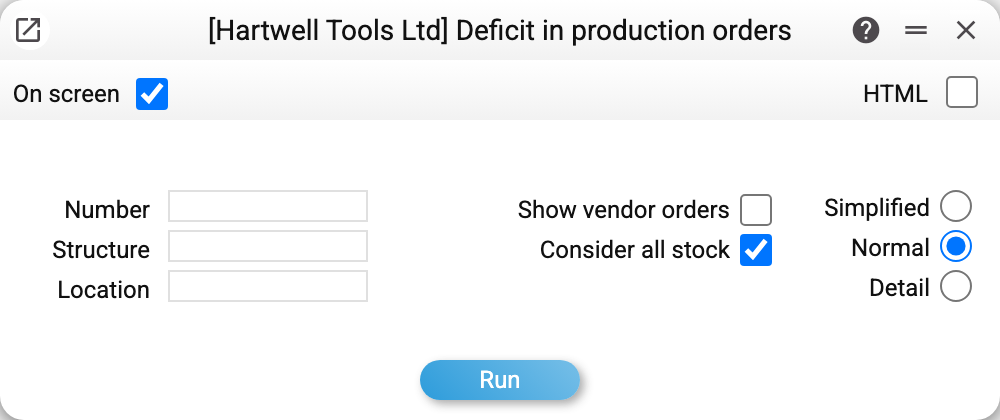
The parameters narrow the selection: order number, technological map («Structure»), location (the window has no status choice — the report always takes both). The «Consider all stock» box (ticked from the start) tells it to add stock up across the company rather than take the order's location; the «Show vendor orders» box adds the columns of goods already on order from vendors and counts them as cover. The view switch: «Normal» (the default) merges orders with the same map into one finished-product line (without «Consider all stock» — per location); «Detail» shows every order separately, with its number and status; «Simplified» lists only the components with their total need.
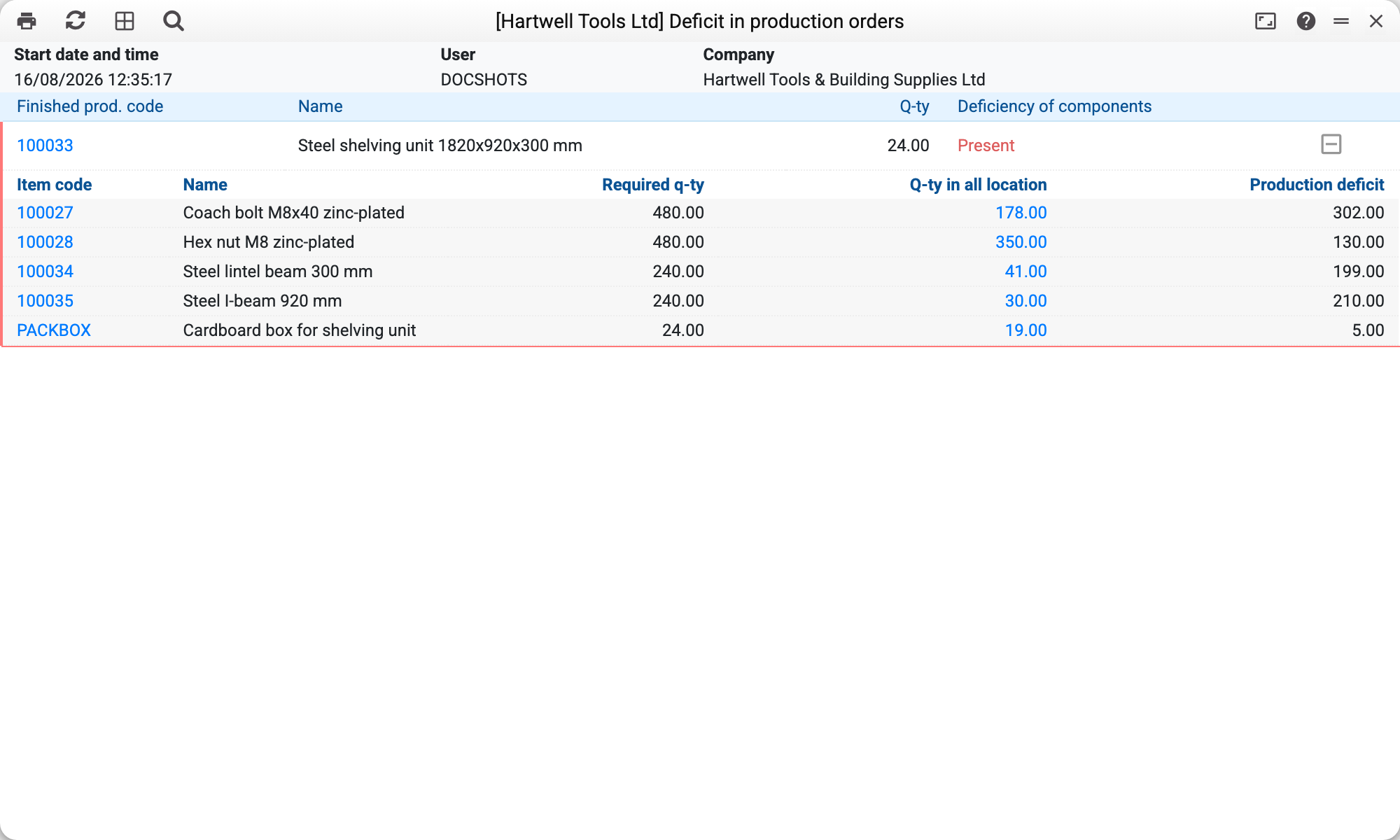
The top line is the finished product: 100033 "Steel shelving unit", 24.00 units — the two open orders combined — with the red verdict "Deficiency of components: Present".
The expanded block shows where that verdict comes from:
| Item | Name | Required q-ty | Q-ty in all location | Production deficit |
|---|---|---|---|---|
| 100027 | Coach bolt M8x40 | 480.00 | 178.00 | 302.00 |
| 100028 | Hex nut M8 | 480.00 | 350.00 | 130.00 |
| 100034 | Steel lintel beam 300 mm | 240.00 | 41.00 | 199.00 |
| 100035 | Steel I-beam 920 mm | 240.00 | 30.00 | 210.00 |
| PACKBOX | Cardboard box | 24.00 | 19.00 | 5.00 |
Every component is short: the plan of 24 units needs 240 beams and there are 30. That last column is the shopping list.
There is a third verdict too — «Unlikely»: the stock is short, but vendor orders cover the gap (only with «Show vendor orders» ticked).
Reading the columns
- Required q-ty — the consumption from the order line (its make-up came from the technological map) times the order quantity, minus what the productions of this order have already consumed;
- «Q-ty in all location» — free stock, with warehouse reservations deducted, that is left for this line after those earlier in the queue (see below). Without «Consider all stock» it is replaced by «Q-ty in current location» (the order's location) and «Q-ty in other location»;
- «In unappr. ordered supplier» and «In appr. ordered supplier» — with vendor orders ticked: open purchase orders for the item;
- Production deficit — how much is short; with vendor orders ticked, counting them as well.
The queue. When several orders need the same item, the stock (and the vendor orders) goes to them in turn — by planned start date, and by number when the dates are equal: each takes from what the earlier ones left. In the «Detail» view every order stands in the queue; in «Normal» it is the merged line of a map, placed by its earliest order. Lines come in queue order, so you can see who took the stock first. The «Simplified» view has no queue: the need of all orders is compared with the stock as one sum, and the stock also counts what open production orders for the same item (a semi-finished product) have not produced yet.
The finished-product line expands by itself when there is a shortfall («Present» or «Unlikely»). With no shortfall the block stays collapsed — open it with the plus on the right.
Typical situations
The report used to fail when no filter was set. Fixed on 16/08/2026; an empty filter now means "all orders".
There is a shortfall, but a delivery is on its way. Tick «Show vendor orders»: vendor orders then count as cover, and a line whose gap they close becomes «Unlikely».
Only one location matters. Clear «Consider all stock» and name the warehouse: the report takes the orders of that location and compares them with the stock there.
Where to look next
- Product orders — the plan being checked.
- Deficit in production — the same idea for runs already started.
- Production capabilities — the view from the other side: what stock allows you to make.
- Purchase Orders from Deficit — the service that creates draft purchase orders for exactly this shortage.